
When most people think of traditional Chinese Kung Fu, their mind often jumps to dramatic forms, long flowing robes, and high-flying kicks from old martial arts films. But few realise how deeply tactical (and brutally effective) some lineages can be. One of the most unique and hard-hitting systems to emerge from southern China is Buk Sing Choy Lay Fut, and at its heart is the legacy of one man: Master Tarm Sarm.
So what exactly sets Buk Sing apart? Why does it stand out among other styles like Hung Gar or standard Choy Lay Fut? Let’s take a look.
From tradition to transformation: Tarm Sarm’s evolution of Choy Lay Fut
Buk Sing Choy Lay Fut was forged in the crucible of real combat.
Originally trained in Hung Ga, a powerful, close-range southern system, Tarm Sarm was later introduced to Choy Lay Fut through a match that changed everything. After being floored by the technique of a Choy Lay Fut practitioner, he didn’t walk away bruised. He walked away curious.
He sought out Master Lui Chang of the Hung Sing school, and after proving himself in a fight (and being knocked down again), he was accepted as a student. Tarm Sarm quickly rose through the ranks but was eventually expelled after a conflict with senior students. Not one to stop, he completed his training through his friend Wong To. And then, something remarkable happened.
He made it better.
What Tarm Sarm created was a version of Choy Lay Fut that was streamlined, efficient, and brutally effective in real fights. His adaptations were born of constant challenge matches and experience in the ring. He combined long-range strategies from Northern Shaolin (Buk Sil Lum) with the circular strikes and explosive power of Choy Lay Fut to create something more direct, more agile, and more modern.
What makes Buk Sing different?
Here’s how Buk Sing Choy Lay Fut stands apart from other traditional Kung Fu systems:
- It’s built for fighting, not just forms:
While many schools focus on aesthetics and tradition, Buk Sing was designed for real-world application. Tarm Sarm and his students were known for their full-contact sparring and tournament success. Techniques were battle-tested and constantly refined. - Long-range power, short-range ferocity
Buk Sing integrates long-arm techniques like the whipping panther fist (charp chui) and swinging backfist (gwa chui) with devastating close-range combinations. The footwork is lateral and mobil, designed to create angles and apply pressure, not just hold a stance.
This differs significantly from styles like Hung Gar, which favour rooted stances and power generated from low, stable positions. Buk Sing, by contrast, is all about flow, reach, and rhythm.
- The Buk Sing stance: wide, mobile, and ready to strike
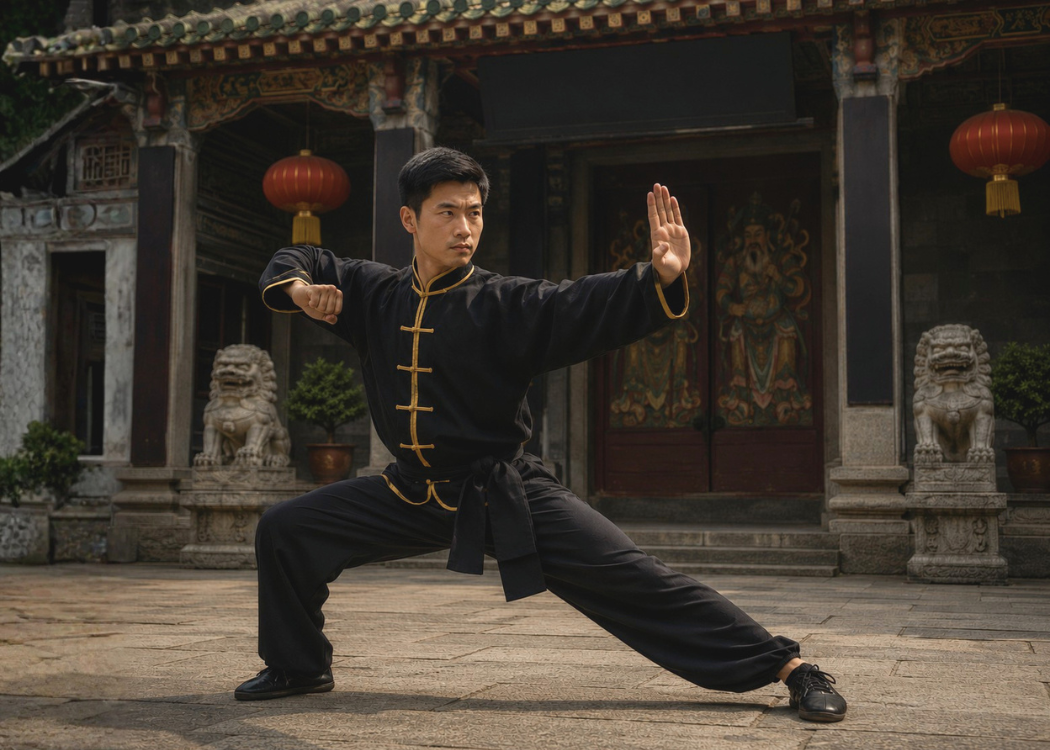
A key feature is the Dy Ma (wide horse stance) combined with Peen Sun (sideways body). These allow the fighter to cover distance, generate torque through the hips, and switch ranges fluidly. - It embraces innovation without losing tradition
Tarm Sarm didn’t abandon tradition, he enhanced it. He was known for observing other styles, testing his own skills against theirs, and integrating only what worked. Buk Sing became a synthesis of strength, speed, and strategic intelligence.
Why it still matters today
Many modern martial arts schools dilute their content to appeal to the mainstream. But at the Chinese Kung Fu and Tai Chi Academy, the original Buk Sing code is alive and well. Our forms, training methods, and fight strategies are preserved through direct lineage from Sifu George Michielsen, who learned under Masters Vince and Dave Lace, students of Kong Hing, son of Kong On, one of Tarm Sarm’s top disciples.
This isn’t just a style. It’s a legacy of fighters who trained for real combat. It’s a system that values respect, structure, and mastery through repetition, not shortcuts.
The final word
If you’ve ever felt like modern fitness trends are missing depth, or that something ancient might actually hold the key to your power, Buk Sing might be the art you didn’t know you were looking for.
It’s not about doing more. It’s about doing better. Slower. Stronger. With more intent.
Ready to experience it for yourself?
🔥 Check out our courses to discover a system that was built to win.
[Insert link]
