You’ve probably seen the word Qigong before, and you might know it involves slow movement and breathing… but it can feel like you’re only seeing the surface.
So what is Qigong, really?
The truth is, Qigong is far more than what it looks like. It’s a complete internal system designed to build energy, restore balance, and strengthen the body from the inside out.
Let’s start with the name itself.
Breaking it down
‘Qi’ (pronounced ‘chee’) is the Chinese term for life force energy. It’s the vital energy that flows through every living thing, through the body via pathways called meridians, through nature, through the universe. Traditional Chinese medicine has been working with Qi for thousands of years. Acupuncture, herbal medicine, and internal martial arts are all, at their core, working with the same underlying principle: that the quality and flow of Qi in the body determines your health, your strength, and your resilience.
‘Gong’ means work, skill, or cultivation. It refers to the dedicated, consistent practice required to develop something over time.
Put them together and you have ‘the cultivation of life force energy.’ That’s Qigong. A deliberate, disciplined practice of working with the energy inside and around you.
What Qigong actually looks like
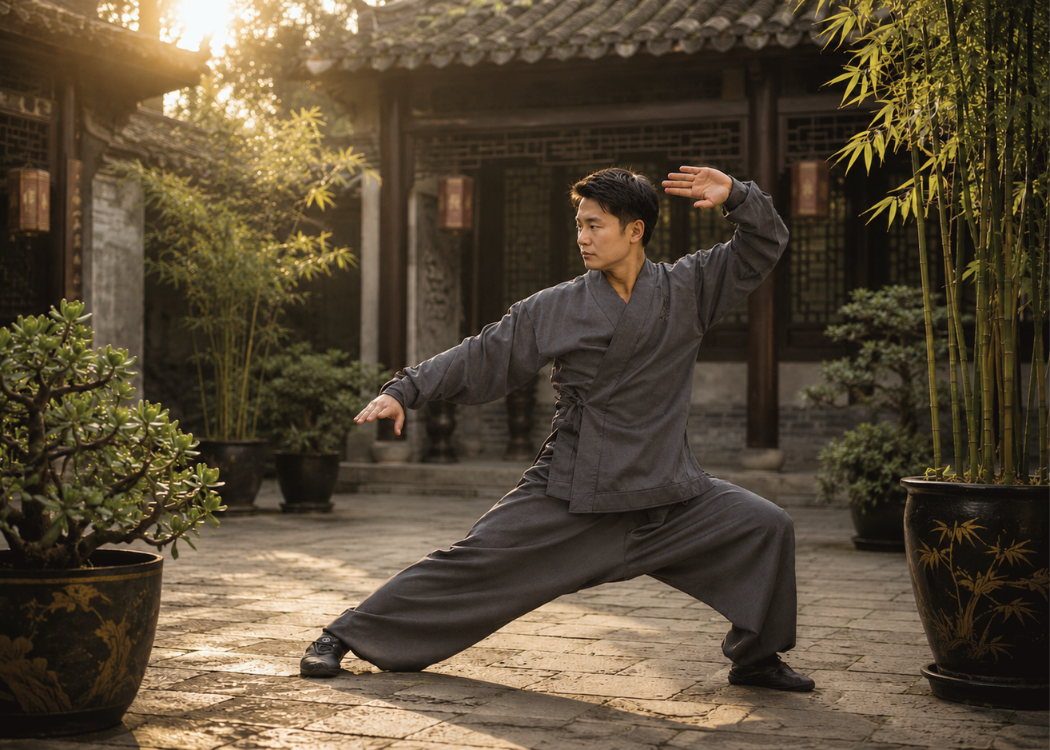
From the outside, Qigong can look deceptively simple. Slow, deliberate movements. Controlled breathing. Still, focused posture. Sometimes standing meditation where, to the untrained eye, nothing appears to be happening at all.
But underneath that stillness, something significant is taking place. The practitioner is directing attention inward, using breath and movement to circulate Qi through the body’s energy channels, opening blockages, revitalising organs, and calming the nervous system.
It’s not exercise in the conventional sense. There’s no heart rate target, no reps to hit, no muscle to exhaust. The goal is something different: building internal power, restoring balance, and creating the conditions in which the body can heal and function at its best.
A practice born in the Shaolin Temple
The Qigong systems taught at the Chinese Kung Fu and Tai Chi Academy trace their roots to the Shaolin Temple in China, one of the most significant centres of traditional martial arts in history. The Shaolin monks understood that true strength came from the inside out. Physical conditioning without internal cultivation was incomplete. So alongside their rigorous martial training, they developed sophisticated Qigong systems to build Qi, protect the body from injury, and sustain the kind of health and vitality that allowed them to train for a lifetime.
These systems were closely guarded for centuries, passed down only within trusted lineages, never shared carelessly with the outside world. What makes the Qigong practiced here so rare is that it comes directly through those lineages, through masters who received the knowledge personally and preserved it in its original, undiluted form.
Why people practice today
Most people who come to Qigong aren’t monks, they’re ordinary people dealing with modern problems of exhaustion, chronic stress, poor sleep, inflammation, anxiety, and a general sense that their body isn’t functioning the way it should.
Qigong meets all of these things directly. The combination of intentional breath, focused movement, and internal awareness calms the nervous system in ways that conventional exercise rarely does. In fact, many people find that stress hormones settle, sleep improves and energy levels stabilise.
But for those who go deeper, Qigong offers a path to internal power, the kind of strength that doesn’t fade with age because it isn’t built on muscle alone. It builds structural alignment, joint health, and energetic resilience. It becomes a daily ritual that grounds you, not just a practice you do for your health but a way of being you carry into everything else.
Where to begin
There are different Qigong systems, each with their own character and focus. Lohan Qigong, rooted in the 18 Lohan form of the Shaolin Temple, is deeply restorative and calming, built to harmonise the body’s energy and support healing. Sinew Qigong, drawn from the legendary Yi Jin Jing (Muscle-Tendon Transformation), is more physically forging, strengthening the tendons and building the kind of internal power that warrior monks used to develop extraordinary resilience.
For many practitioners, Qigong also grows naturally alongside a martial arts path, deepening internal strength and bringing new layers of understanding to every form and technique trained.
Remember, Qigong is for everyone. You don’t need experience and you don’t need equipment. You just need need your body, your breath, and the willingness to show up consistently. The rest follows.
