
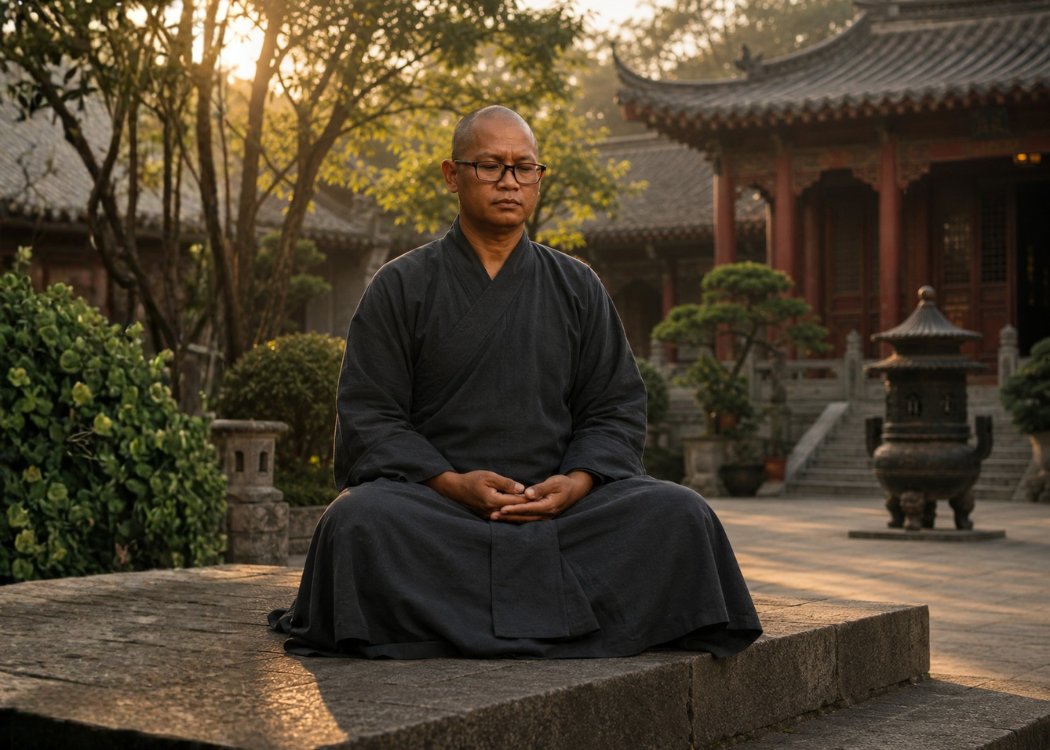
If you’ve spent any time reading about traditional Chinese martial arts, you’ve probably encountered the term ‘internal power.’ It can feel slightly vague or mystical, which tends to put people off or make them suspicious. But the concept itself is a specific, trainable quality of movement, and once you understand what it, it becomes one of the most compelling reasons to pursue a traditional martial arts practice.
What internal power is not
Internal power isn’t a special gift that certain people are born with and it isn’t reserved for masters who have trained for 50 years. In fact, it’s something that anyone can acces – if you know how.
The mystery around internal power comes largely from the fact that it’s difficult to describe in the language most people use for physical training. It doesn’t fit into conventional categories of strength, speed, or flexibility. It looks different from the outside than it feels from the inside. And it tends to be demonstrated rather than explained, because the gap between understanding it intellectually and feeling it in your own body is significant.
But it is real. And it is learnable.
What internal power actually is
At its most practical, internal power is the ability to generate and transmit force through the body as a connected, unified system, rather than through isolated muscular effort. It’s the difference between a punch thrown from the arm and a punch that originates from the ground, travels through the legs, hips, and core, and arrives at the striking surface with the weight of the entire body behind it.
The external movement might look similar. The effect is not.
In Chen Tai Chi, this quality shows up most visibly in fajin, the sudden explosive release of stored energy that defines the style’s most dramatic moments. What makes fajin so striking to watch, and so difficult to replicate without proper training, is that it doesn’t look like it should produce the force it does. The practitioner appears relaxed. The movement is compact. And yet the power generated is substantial. This is internal power in action: force produced through whole-body integration, structural alignment, and precise timing rather than through muscular contraction alone.
In Choy Lay Fut Buk Sing Kung Fu, the same principle expresses itself through the long-range circular strikes that define the style. The circular, whipping power that makes these techniques so effective comes from the whole body rotating as a single connected unit, with the arm as the final expression of a force that begins in the stance and travels upward through the entire structure.
How it is developed
Internal power develops through three interconnected practices, all of which feature throughout the online courses at the Chinese Kung Fu and Tai Chi Academy.
The first is structural alignment. Before the body can transmit force efficiently, it needs to be properly aligned. This is what stance training, posture work, and the careful attention to body mechanics in every course level are building. A body that moves with correct structure creates the pathways through which internal power can travel.
The second is silk-reeling, the continuous spiralling movement that runs through Chen Tai Chi and aspects of Choy Lay Fut training. Silk-reeling develops the connective pathways between the body’s segments, training them to work together in a continuous, unbroken flow rather than as separate units. This is the quality that makes internal power feel so different from muscular strength. The force doesn’t come from one place. It comes from everywhere at once.
The third is breath and Dantian activation. The Dantian, the body’s core energy centre located in the lower abdomen, is where internal power is cultivated and from which it is expressed. Learning to breathe into this centre, and to direct force from it outward through the limbs, is the internal dimension of the practice that transforms technically correct movement into something qualitatively different.
Sinew Qigong develops this further still, conditioning the tendons and connective tissue through dynamic internal tension in a way that builds the structural resilience and whole-body connection that internal power depends on.
Can anyone develop it?
Yes. Genuinely, yes.
Internal power isn’t a talent. It’s a skill, and like all skills it develops through correct practice over time. What it requires is access to authentic instruction that teaches the underlying principles rather than just the surface movements, and the consistency to apply those principles until they become second nature.
This is exactly what the structured, progressive courses at the Chinese Kung Fu and Tai Chi Academy are designed to deliver. Every course level teaches not just the ‘what’ of each movement but the ‘why’ and the ‘how,’ the structural principles, the breath work, the internal connections that turn external shapes into genuine martial skill.
You don’t need a special background. You don’t need prior experience. You need the willingness to start, and the patience to let the practice develop you from the inside out. Explore the courses here.
