
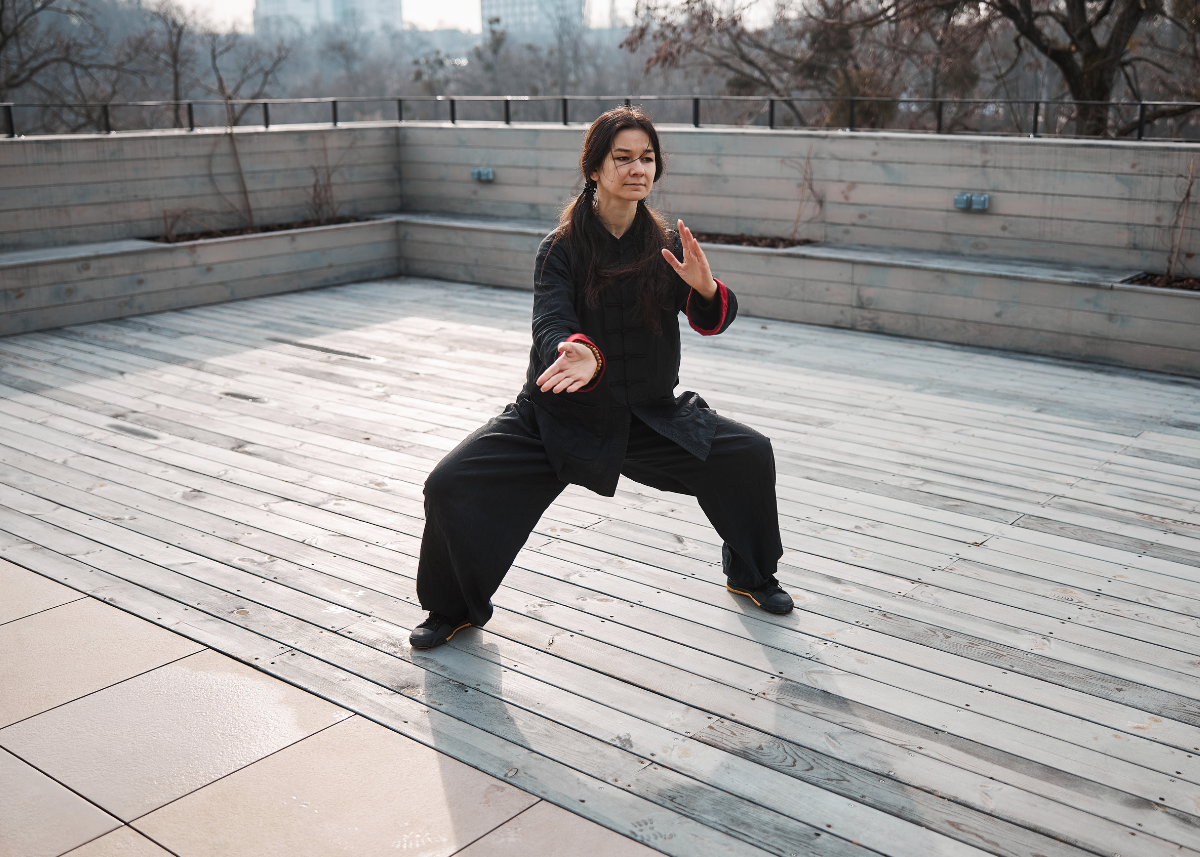
If you’ve been curious about how to start Kung Fu training at home, the good news is that you need less than you think. You don’t need the perfect setup, the right gear, or a school to open up near you. Your living room is a perfectly good place to start, and the foundations you build there are exactly the same ones that carry you forward through years of training.
This is a guide for anyone who wants to begin, whether you’re completely new to martial arts or returning to something you’ve always wanted to explore more seriously.
The foundation is simpler than you think
One of the biggest myths about Kung Fu is that you need years of in-person training before anything real happens. The truth is that the most important things you can develop as a beginner, body awareness, breath control, focus, and physical conditioning, are all built through solo practice. And they’re built through repetition of simple, foundational movement.
You don’t need to know twenty techniques. You need to know a few things well. A strong stance, a clean strike, a controlled breath. The practitioners who look effortless after years of training aren’t doing something different from what you’d start with. They’ve just done it a lot more times.
That means the gap between where you are now and where you want to be is bridged by something completely within your control.
What you actually need to get started
A space roughly two metres by two metres is all you need, plus some comfortable clothes you can move in. That’s it. No equipment, no uniform, no prior experience required.
The students who progress fastest in Kung Fu aren’t always the most naturally talented or the most athletic. They’re the ones who show up consistently. A short daily practice will take you further than an occasional long session ever will. The body learns through repetition, and repetition requires regularity.
Some days you’ll feel more strong and focused than others, but the practice rewards the decision to return, more than it rewards any single outstanding session.
The other thing consistency does is change how you see yourself. After a week of daily training, you’re someone who trains daily. That identity shift is powerful and carries you through the days when motivation is low.
Learn through authentic structured instruction
One of the most valuable things you can do for your home training is to learn a genuine form through expert, structured guidance. Forms are the backbone of traditional Kung Fu. They encode technique, footwork, strategy, and internal principles into sequences that can be practised solo, refined over months and years, and deepened for a lifetime.
The online courses taught by Sifu George Michielsen through the Chinese Kung Fu and Tai Chi Academy offer exactly this. The Dune Da course at Gold level is a natural starting point: a direct, efficient Southern Shaolin form originally taught to the Chinese army, designed to give practitioners access to real Kung Fu strategy quickly. Each movement is taught from multiple angles with application breakdowns, so you understand not just the shape of what you’re doing but what it means and how it works.
What makes learning this way so effective is that you have access to Sifu George’s instruction on your own schedule, at your own pace, and with lifetime access to revisit and refine as your understanding deepens. You’re not watching a random video and guessing. You’re following a structured, progressive system built by someone who has spent decades preserving and transmitting these arts through authentic lineage.
The private community that comes with each course also means you’re never training alone. Q&A sessions, coaching, and the support of other practitioners are all available, which is a genuine advantage of learning this way.
The right mindset from day one
Traditional martial arts have a culture of respect, discipline, and long-term thinking that is worth bringing into your home practice from the very beginning, even when no one is watching.
Show up at the same time each day. Bow before and after your session. Take each repetition seriously. Give the basics the same attention you’d give the impressive techniques, because the basics are what the impressive techniques are made of.
These habits are the cultivation of a quality of mind that the arts were specifically designed to develop. The way you approach training at home is the way you’ll approach it everywhere else, so it’s worth getting that right from the start.
So start simply. Start consistently. And bring the same respect to your living room floor that you’d bring to any kwoon. The training will meet you there.
