If you’ve ever looked into martial arts for yourself or someone else, you’ve probably landed on this question fairly quickly. Kung fu and karate are the two names most people reach for, partly because of popular culture and partly because both have been taught widely in the West for decades. Both martial arts offer incredible paths toward self-discipline and physical fitness, but they each tell a unique story through their techniques.
So what makes kung fu and karate different? Let’s look into it.
Where they come from
The most fundamental difference between kung fu and karate is geographical and cultural.
Kung fu is Chinese. It draws on thousands of years of Chinese martial history, philosophy, and cultural practice. The Shaolin Temple, founded in the fifth century, played a central role in developing and systematising many of the principles that still underpin traditional kung fu today. Over the centuries, hundreds of distinct styles emerged across China, each shaped by the region, the family or school that developed it, and the specific martial and philosophical problems its founders were trying to solve. Choy Lay Fut, Wing Chun, Northern Shaolin, Hung Gar, and Chen Tai Chi are all kung fu, but they are also meaningfully distinct arts with their own histories, techniques, and internal logic.
Karate is Japanese, developed primarily in Okinawa before spreading to mainland Japan in the early twentieth century. It draws on earlier Okinawan fighting systems, which themselves absorbed some influence from Chinese martial arts through trade and cultural contact over the centuries. Karate was systematised and spread more deliberately as a unified practice than most Chinese arts, particularly after it entered the Japanese physical education system in the 1920s. That process of standardisation gave karate a degree of structural consistency across schools that Chinese kung fu, with its diversity of regional styles and family traditions, never had.
How they move
This is where the difference becomes most visible, and where personal preference often becomes the deciding factor in kung fu vs karate.
Karate favours linear movement. Strikes tend to travel in straight lines, blocks are distinct defensive actions, and the overall quality of movement is angular and precise. The stance work is strong and grounded. There is a clarity and economy to classical karate technique that many people find immediately satisfying to train, because the structure is clear and the corrections are concrete.
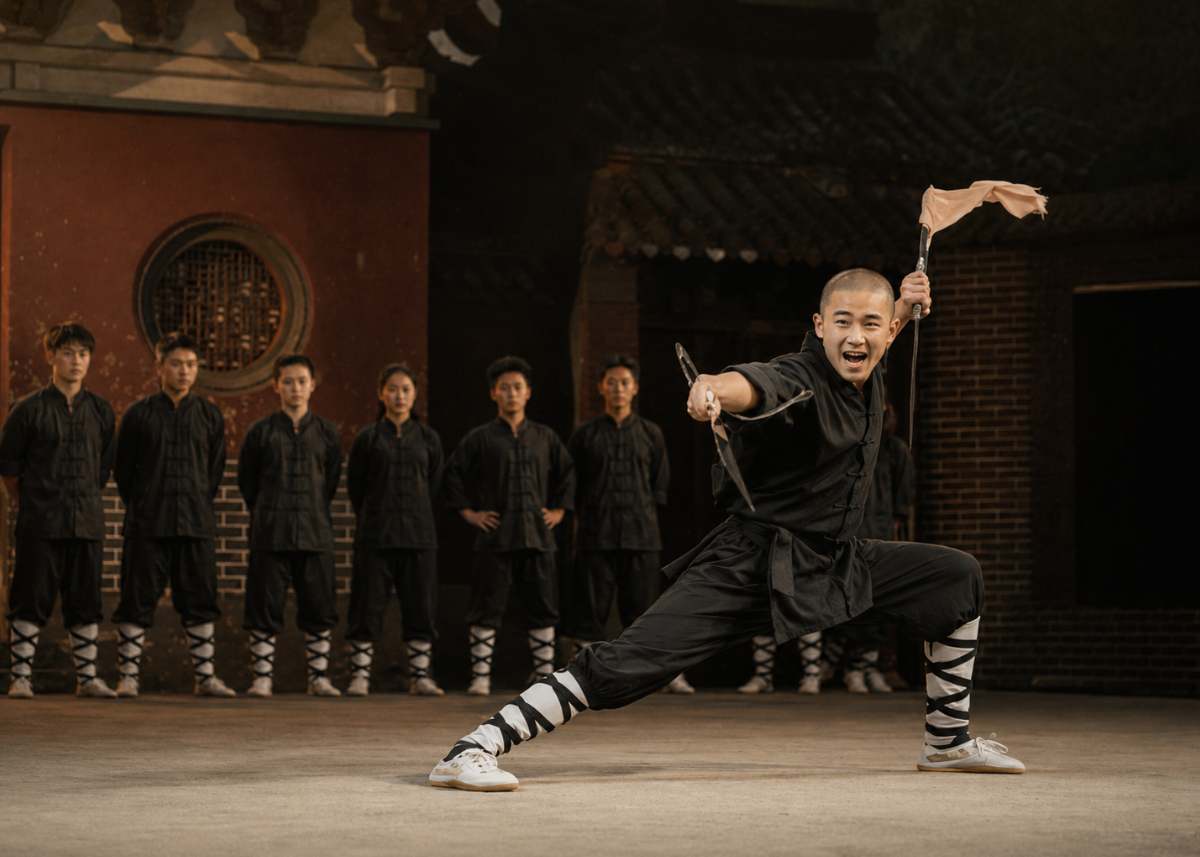
Kung fu, on the other hand, moves differently. The Southern Chinese styles, like Choy Lay Fut Buk Sing, use sweeping circular strikes, wide grounded stances, and a flowing quality of movement that generates power through the whole body rather than through isolated muscle groups. The Northern styles add high kicks, acrobatic footwork, and long-range techniques that use the full extension of the limbs. Both differ from karate in their emphasis on continuous, flowing combinations rather than individual techniques delivered and retracted. A well-executed Buk Sing combination does not stop between strikes. It uses the recoil of one technique to generate the next, building momentum through the sequence.
One Academy student who had trained in karate before finding kung fu described the Japanese arts as feeling too rigid, lacking the speed and fluidity that drew them to Chinese martial arts. That is a personal perception rather than an objective truth, but it captures something real about the difference in movement philosophy between the two traditions.
The internal dimension
This is perhaps the most significant difference between kung fu and karate, and the one that tends to matter most to people who stay in their art for a long time.
Traditional Chinese martial arts carry a deep internal training dimension that has no real equivalent in mainstream karate. Qigong, the cultivation and circulation of internal energy (Qi), sits at the heart of many of the Chinese systems, including those taught at the Academy. The 18 Lohan Qigong, the Sinew Qigong (Yi Jin Jing), and the internal principles embedded in Chen Tai Chi all develop a quality of body awareness, structural power, and energetic cultivation that practitioners describe as fundamentally different from anything produced by external conditioning alone.
This internal dimension is a sophisticated and systematic approach to developing power from the inside out, through breath, alignment, intention, and years of patient practice.
Karate does have its own internal traditions, particularly in Okinawan systems like Goju-ryu, and serious karate practitioners develop genuine depth and body intelligence over long training careers. But the breadth and sophistication of the internal training dimension in traditional Chinese martial arts is, by most measures, considerably greater than what most karate students encounter.
The philosophical framework
Both arts carry a philosophical dimension that extends beyond physical technique, but they carry it differently.
Karate borrowed heavily from Japanese Budo culture when it spread to mainland Japan, absorbing values like discipline, respect, and the refinement of character through martial practice. These are genuine and important dimensions of the art. The belt system, the dojo etiquette, the emphasis on courtesy: all of these reflect a serious philosophical tradition.
Traditional kung fu carries its own framework, rooted in Chinese philosophy, Confucian values, and in many systems, Buddhist or Taoist influence. The lineage structure, the relationship between sifu and student, the code of respect that governs how knowledge is transmitted: these are not formalities. They are the container within which the knowledge lives. A student who learns kung fu without understanding or honouring that container is, in the view of traditional schools, not really learning kung fu at all. They are learning a collection of techniques with the most important parts removed.
At the Academy, this philosophical dimension is treated as inseparable from the physical training. The five core values, respect, self-discipline, integrity, loyalty, and preservation of knowledge, are the operating principles of how the school runs and how knowledge is shared.
So which should you learn?
The honest answer is that the right martial art is the one you will actually stick with, because consistency over years matters far more than which tradition you choose. Both kung fu and karate reward long-term commitment, and both will make you a more capable, disciplined, and self-aware person if you train them seriously.
That said, if you are drawn to a richer diversity of styles, a deeper internal training dimension, a philosophical framework rooted in Chinese culture, and a curriculum that includes everything from explosive Southern fighting arts to qigong and internal tai chi, then kung fu offers something that karate does not quite match in breadth or internal depth.
And if you want to explore that world without needing to find a school near you, our online courses bring the full curriculum of Buk Sing Choy Lay Fut, Chen Tai Chi, Lohan Qigong, and Sinew Qigong directly to you, wherever you are, taught by Sifu George Michielsen and grounded in a lineage that has been carefully preserved and passed down through generations. Browse our courses and find where your path beginsExplore our courses
