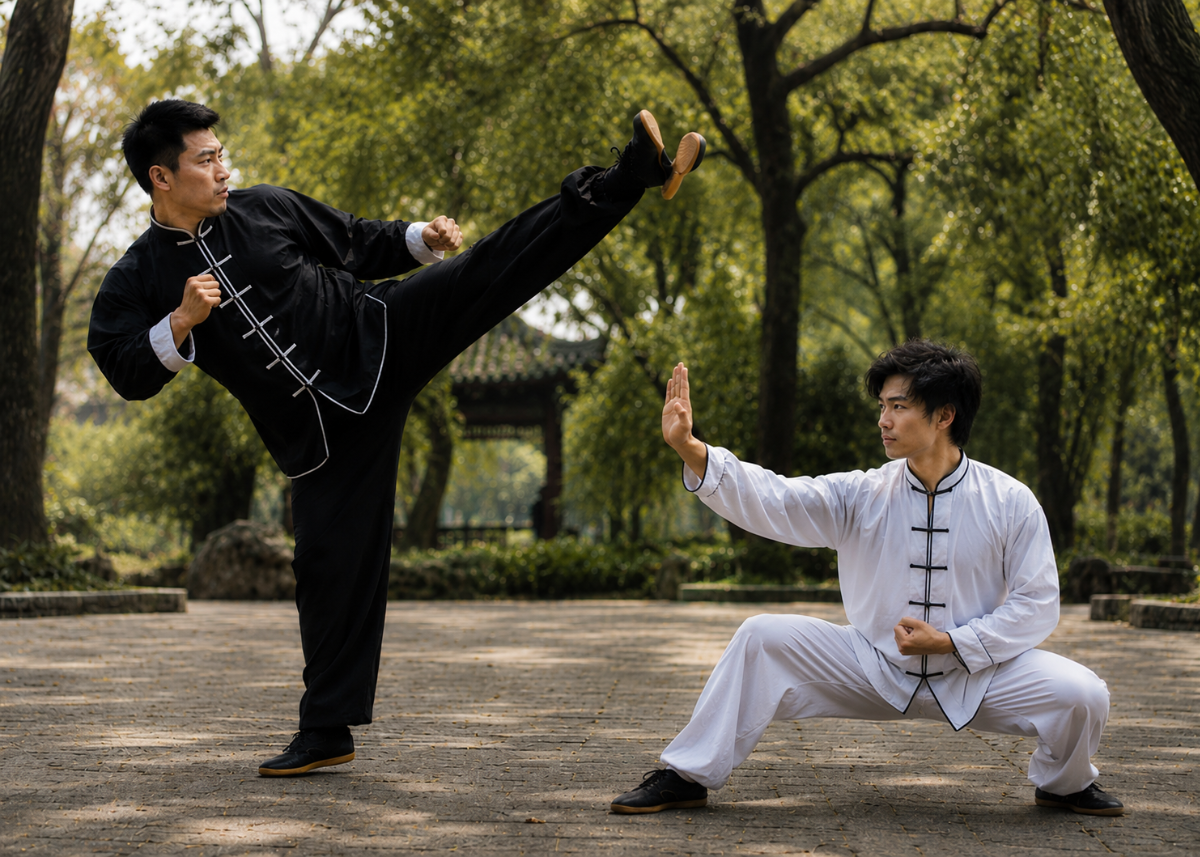
If you were to draw a line across the middle of China. On one side, you’d find wide open plains, cold winters, and fighters with sweeping kicks, high leaps, and long fluid stances. On the other, you’d find dense river delta towns in the south, producing an art that is powerful, grounded, and devastatingly effective at close range.
That is the basic geography of Northern and Southern kung fu. But the story of how those two worlds eventually found each other, and what happened when they did, is one of the most important chapters in the history of Chinese martial arts.
Two philosophies, one country
Northern kung fu, and in particular Buk Sil Lum (Northern Shaolin), prizes reach. Practitioners use the full range of the body, extending through the hips, shoulders, and limbs to generate power across distance. The movements are often larger, more acrobatic, and built for open engagement. You see it in the high kicks, the spinning footwork, the sweeping arcs of the sabre. Northern training builds athleticism, agility, and the ability to control space.
Southern kung fu developed under different pressures. The climate is humid, the terrain often confined, and the practical demands of self-defence in southern Chinese cities, including port towns like Canton and Foshan, favoured a more grounded approach. Southern styles plant the stance wide and low, generate force through the waist and hips, and favour short, explosive power at close quarters. The legs stay mostly below the waist. The hands do the heavy work.
Neither tradition is better. They simply answer different questions about how a body moves and where danger comes from.
The Southern styles and their roots
The most significant Southern styles all trace back, in some way, to the Shaolin Temple and the families that developed the art after the temple’s destruction scattered its monks across China. Choy Lay Fut, one of the most widely practised Southern systems in the world, traces its founding to Chan Heung in 1836. It draws on the Choy family, the Lay family, and the Buddhist (Fut) tradition, weaving together the swift footwork of Choy Gar, the muscular strength of Hung Kuen, and the long strikes of the Lay lineage into a single cohesive system.
Choy Gar itself, one of the five original Southern family styles, specialises in rapid, darting footwork and lightning-fast hand strikes. It builds the kind of agility that makes a fighter unpredictable, hard to pin, always moving. Chow Gar Kung Fu, founded by Grandmaster Chow Loong, draws on simultaneous attack and defence, described at the time as having the head of Hung, the tail of Choy, and the patterns of tiger and leopard. Its five founding brothers became known as the Five Tigers of Chow Gar, a dominant force in Kwangtung Province for nearly half a century.
These styles are related but distinct. Each reflects the personality, experience, and innovation of the people who created them.
What Northern Shaolin brought to the south
In the 1920s and 1930s, something remarkable happened. Grandmaster Tarm Sarm, the founder of Buk Sing Choy Lay Fut, was already a feared and accomplished Southern fighter when he encountered Ku Yu Cheung, one of the greatest Northern Shaolin practitioners of the era. By that point, Ku Yu Cheung had trained in Buk Sil Lum for eleven years, studied Tai Chi Chuan and sword under separate masters, and built a reputation for extraordinary physical power. He could bend iron bars around his arm, break twelve bricks with bare hands, and withstand a truck driving over his body.
Tarm Sarm and Ku Yu Cheung sparred for three days. Neither man claimed victory. Out of that mutual respect, they agreed to something unusual for the era: an exchange of students. Kong On, who would later become one of Tarm Sarm’s six top disciples, was among those selected to train under Ku Yu Cheung. This exchange is considered, even today, one of the greatest events in Chinese martial arts history.
What Tarm Sarm learned from it changed everything. He saw that Buk Sil Lum was a long-range system, that it used the full extension of the body in a way his Southern training had not. He took that insight and applied it to Choy Lay Fut, pushing maximum reach into techniques that had previously worked at shorter distances. The result was Choy Lay Fut Buk Sing: a fighting system that remained undefeated for 50 years.
What makes Buk Sing different
Buk Sing Choy Lay Fut is recognisable by three defining characteristics: the wide horse stance (Dy Ma), long hand movements (Cheung Kiu), and the sideways stance (Peen Sun). These are not decorative. Each one serves a specific fighting purpose, rooted in the principle Tarm Sarm embedded into the system: every inch is an inch of power.
Where traditional Southern Choy Lay Fut favoured shorter-range technique, Buk Sing extends that range deliberately. The panther fist (Charp Chui), the back fist (Gwa Chui), and the roundhouse swinging punch (Sau Chui) all carry the full weight of the body behind them, thrown from a grounded stance into the longest possible distance. This is Northern principle inside a Southern structure.
Kong On, who trained under both Tarm Sarm and Ku Yu Cheung, absorbed both worlds. He passed that integrated knowledge to his son, Kong Hing, who was mastered in both Northern and Southern fighting arts from childhood. Kong Hing passed it to the Lacey brothers, and through them it arrived in Perth, where Sifu George Michielsen built the Academy that carries it today.
The genius of integration
The great lesson of Northern and Southern kung fu is not that one defeats the other. It is that the best martial minds throughout history understood both, and drew from both without apology.
Tarm Sarm studied Northern technique because he recognised something his system lacked. Ku Yu Cheung respected Southern power enough to send his own students to learn from it. Kong On trained in Chow Gar, Buk Sing Choy Lay Fut, and Northern Shaolin over the course of his life, and became, in the words of those who knew him, one of the most extraordinary martial artists Hong Kong ever produced.
Shane Lacey, son of Sifu Vince Lacey, went on to win five consecutive Grand Champion titles at the International Chinese Martial Arts Championships, taking the overall title across all four divisions: long weapon, short weapon, Southern style, and Northern style. He excelled in Choy Lay Fut Buk Sing, Northern Shaolin, Chow Gar, and Wing Chun alike. That breadth did not dilute his skill. It was the source of it.
The living divide
Today the distinction between Northern and Southern kung fu is still real, and still meaningful. Southern styles remain rooted in their grounded, short-range power. Northern styles continue to develop the athleticism, range, and expressive movement that characterise Buk Sil Lum and its descendants. The traditions remain distinct.
But the most alive and complete systems, those that have endured and proved themselves across generations, carry something from both sides of that line. They carry the groundedness of the south and the reach of the north. The explosive close-range power and the long sweeping extension. The tiger and the leopard.
Ready to train in a system that carries both worlds? Our courses are rooted in authentic Buk Sing Choy Lay Fut lineage, Northern and Southern tradition combined. Browse the courses and find your starting point. Explore our courses
