
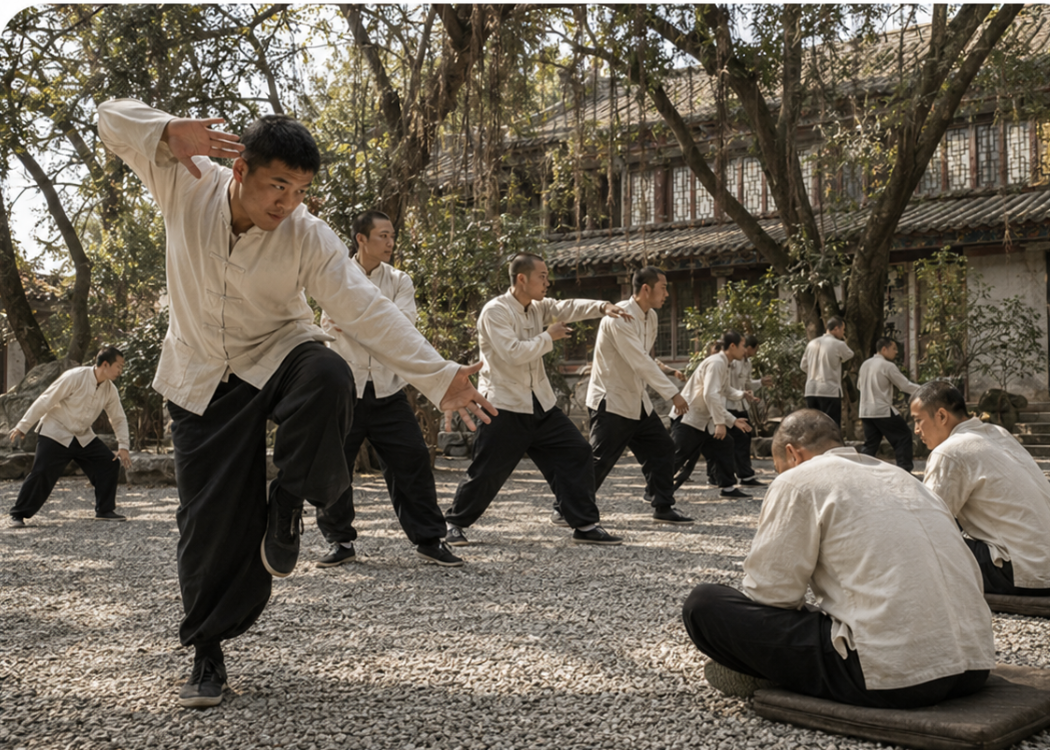
There’s a reason the image of the Shaolin monk still captures people’s imagination, not just for their physical mastery, but for what they represent. Stillness. Clarity. Purpose. A quiet power that comes from knowing who you are and what you stand for.
That energy, or archetype, lives inside all of us. It’s the part that craves structure, depth, and discipline. The part that wants to unplug from noise, to focus, to train, to be shaped by something meaningful. It’s easy to lose touch with this in a culture that prizes speed, stimulation, and distraction. But that doesn’t mean it’s gone.
In fact, it may be needed now more than ever.
We’re constantly being pulled outward — by screens, notifications, to-do lists, social pressure. The nervous system is overstimulated. The mind is scattered. And somewhere in the middle of all that, many people feel disconnected from their bodies, from nature, and from something deeper within themselves.
Kung fu offers a way back — a form of movement meditation and internal martial arts that helps regulate the nervous system and restore balance.
Not through escape, but through effort. Through structure. Through tradition. It invites you into a space where you don’t have to perform, posture, or pretend — just train. And in doing so, you rediscover the monk within: the one who is steady, strong, awake, and quietly capable of handling life as it comes.
At the Chinese Kung Fu & Tai Chi Academy, we teach Buk Sing Choy Lay Fut, a system forged in the fighting grounds of southern China. Its founders were more than warriors, they were thinkers, healers, and masters of the internal world. Their teachings are not only preserved, but profoundly needed today.
What are the benefits of Kung Fu?
At first glance, the benefits of kung fu might seem physical (and they are). You’ll build strength, mobility, coordination, and endurance. You’ll move better, feel more agile, and become more aware of your body. But that’s just the beginning:
- Trains both mind and body: Kung fu develops physical skill and mental resilience at the same time.
- Improves focus and emotional balance: With consistent practice, students often feel calmer, more centred, and better equipped to handle stress.
- Builds patience and confidence: Progress is earned slowly, through repetition, discipline, and showing up even when it’s hard.
- Strengthens the nervous system: Structured forms train breath, timing, rhythm, and intent — helping you shift from scattered to steady, reactive to composed.
- Offers deep connection: Kung fu provides something rare, a sense of belonging to a meaningful tradition, where effort is respected and progress is real.
- Cultivates clarity and direction: More than just movement, it’s a way to meet challenge well, and grow because of it. It’s also a path of healing through movement for those who feel disconnected from their bodies.
Why are more people turning to kung fu?
There’s a quiet shift happening. In the background of a world that constantly pushes speed, productivity, and convenience — more people are seeking something older, slower, and more meaningful.
Some come to kung fu because they’re burned out. Others are simply tired of fragmented fitness trends, quick fixes, or environments that feel disconnected from real teaching. What they often find instead is structure. Depth. A structured martial arts program that asks for effort — and rewards it.
Kung fu doesn’t offer shortcuts. There are no gimmicks here, no promises of overnight change. But for those willing to show up, something real begins to take shape. A stronger body, yes — but also a calmer mind, a clearer sense of direction, a more rooted way of moving through the world.
The physical benefits are obvious — improved coordination, fitness, mobility, and strength. But it’s often the unseen gains that leave the deepest impact: confidence, emotional regulation, discipline, a sense of belonging. A reminder that there is still value in ancient martial arts — and that tradition still has something powerful to offer.
In a time of burnout and overstimulation, kung fu for mental health and stress relief is becoming an anchor for those looking to reconnect.
A way to connect back to the body. To breath. To focus. To purpose.
And once they begin, many never look back.Ready to reclaim your strength, structure, and stillness?
Train in Buk Sing Choy Lay Fut, a system that sharpens your body, calms your mind, and reconnects you with something real. (ADD LINK)
