
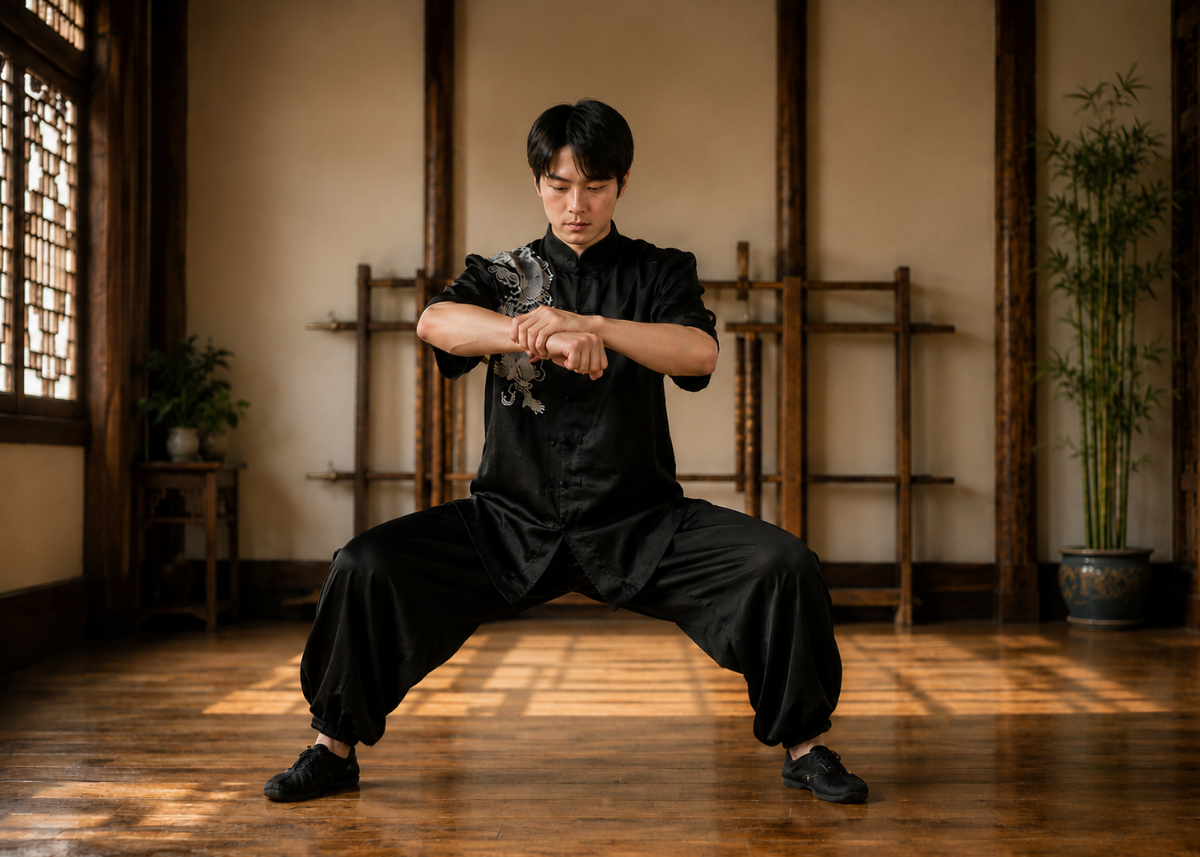
If you’ve ever watched someone training traditional kung fu, you’ve probably seen horse stance. The feet wide, the knees bent and tracking out over the toes, the hips dropped, the back straight. Most beginners assume it is a warm-up exercise or something to get through before the real training begins. But in traditional kung fu, horse stance is not preliminary to the training. It is some of the most important training you will do, and what it teaches goes well beyond the physical burn in your legs.
Where it comes from and why it matters
Horse stance, known in Buk Sing Choy Lay Fut as Dy Ma, is one of the three defining characteristics of the style alongside the long hand movements and the sideways stance. Grandmaster Tarm Sarm, the founder of Buk Sing, built the wide horse stance into the system deliberately. It is the base from which the long-range power of Buk Sing generates, the platform from which every strike, kick, and combination draws its force. Without a grounded, stable, correctly structured stance, the power that Buk Sing is known for simply does not exist.
This is the first thing horse stance training teaches: that everything rests on the foundation – and it’s a physical reality that a student feels immediately. When the stance is too high, strikes lack power. When the weight shifts incorrectly, balance disappears under pressure. When the knees collapse inward, the structure that transfers force from the ground through the hips and out through the hands breaks down entirely. The stance makes all of this immediately and honestly apparent.
What it felt like at Cremorne Arcade
At the Cremorne Arcade school in Perth, where Sifu George Michielsen trained under Masters Vince and Dave Lacey in the late 1970s, every class began the same way: fifteen minutes in horse stance. No movement. No sound. Just the burn in the thighs and the knowledge that the masters were watching. A student who learns to hold their structure when everything in their body is asking them to stand up has learned something that transfers directly into every other aspect of their training.
Kong Hing, one of the great Buk Sing masters and the man who trained the Lacey brothers after Lai Hung, became one of the highest-ranking practitioners in the entire Choy Lay Fut system. His iron palm conditioning began in his earliest years under his father, Kong On. The power he developed, the kind that made Sifu George describe watching him strike as like watching a tiger attack, came from decades of foundational work that started exactly where every student starts: in the basics.
What horse stance training actually develops
The most obvious thing horse stance builds is leg strength and structural stability. But that’s just the beginning. Sustained stance training also develops what traditional schools call ‘root’: the quality of groundedness that allows a practitioner to generate force without being destabilised by it. A student with poor root throws a punch and their own body absorbs the reaction. A student with real root channels that reaction into the ground and stays solid. That difference is entirely built through time in stance.
Horse stance also develops something that’s harder to name but that experienced practitioners recognise: the ability to remain calm under sustained physical discomfort. When the thighs are burning and the mind starts producing excellent reasons to stop, a student who stays down is training their ability to hold focus and intention when conditions are not comfortable. That ability shows up later in sparring, in challenging forms, in the moments of training when the temptation to take the easier path appears. The student who learned to hold stance has a different relationship with that temptation than the one who always stood up when it got hard.
Tarm Michielsen, Sifu George’s son and one of the Academy’s most respected instructors, put it plainly: good kung fu skills are all about being an expert on the basics and building a strong foundation. He has trained since childhood and has represented the school at international level. What he points to, consistently, is not the advanced forms or the competition achievements. It is the basics, returned to again and again, refined across years.
Why it feels like too much and why that is the information
Most students who struggle with horse stance training interpret the discomfort as a sign that something is wrong. They look for ways to make it more bearable: a slightly higher position, a narrower width, a reason to rest. What they are actually experiencing is the resistance that meaningful training always produces, the place where the body and the mind have not yet caught up to the demands being placed on them.
Traditional kung fu does not remove that resistance. It asks the student to meet it, consistently, until the meeting becomes easier. Not because the stance becomes less demanding, but because the student becomes more capable. That process takes time, and it requires showing up to it repeatedly rather than working around it.
The masters in the lineage that shaped this Academy understood something about that process that is easy to miss in the modern training environment: there are no shortcuts to foundation. A student who skips the boring, demanding, uncomfortable work of building their base will always be limited by that absence, no matter how many advanced forms they learn. The stance is not the warm-up. It is the ground everything else grows from.
Beginning where it matters
Our online courses start with the same foundation that has underpinned this lineage for generations. Level 1, Dune Da, teaches the explosive techniques and fighting principles of Buk Sing Choy Lay Fut from the ground up, with stance, structure, and power generation built into every lesson. You learn not just what the movements are, but why they work and what they are asking your body to develop.
If you are ready to build something real, start where every serious practitioner starts. Browse our courses and begin your foundation today.Explore our courses
